
What Is Answer Extraction?
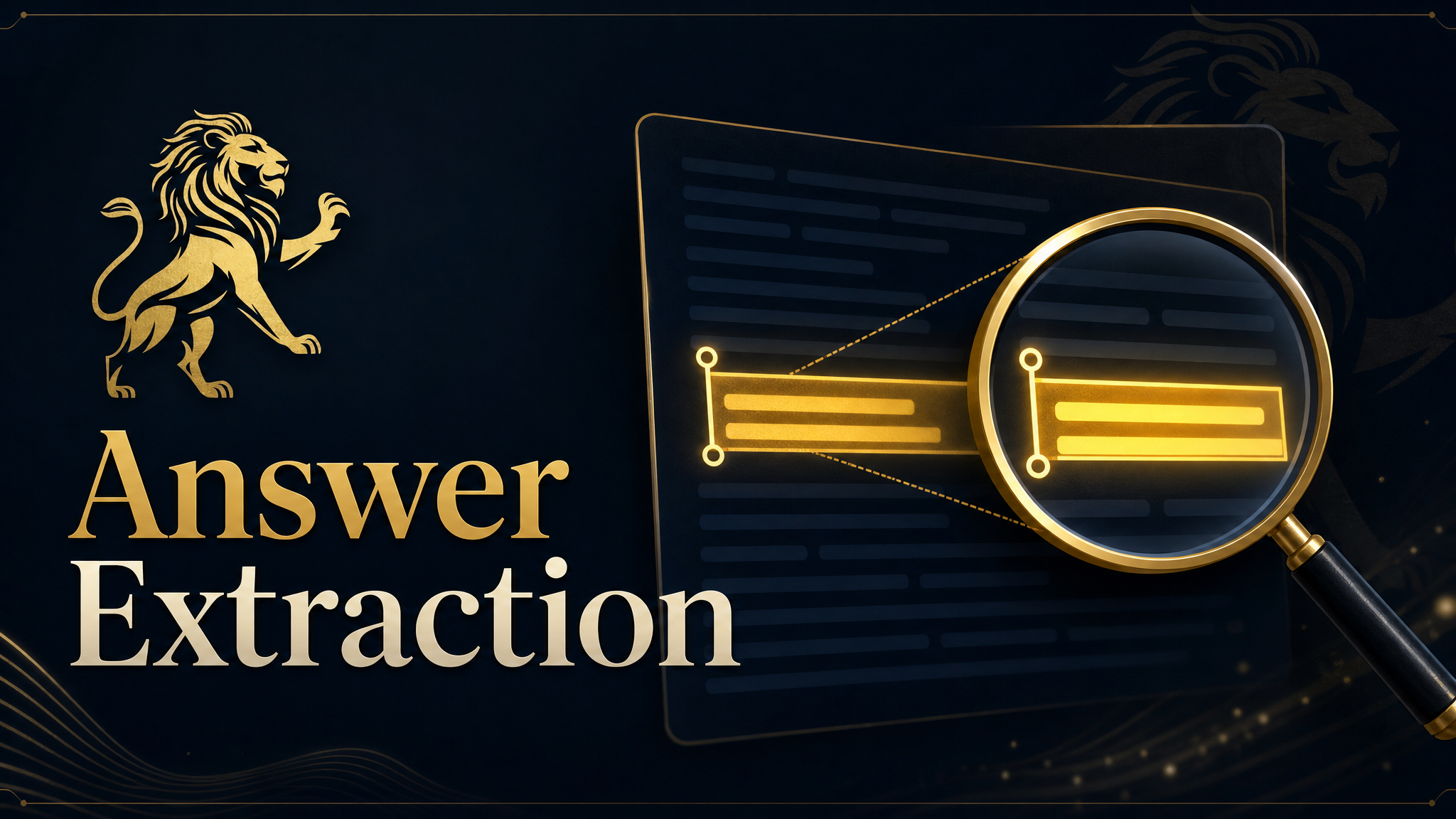
Answer extraction is the NLP task of finding the exact text span in a source passage that answers a user’s question. It powers span-based question answering, search systems, and AI assistants that need to return a precise answer instead of a full document.
Think of it like putting a finger on the sentence that answers the question.
That matters for AI visibility because answer engines don’t want a pile of pages. They want the clearest answer they can cite. If your content buries the answer, the system has to work harder to find you.
In my work with professional service firms, this is one of the easiest gaps to spot. The expert has the answer. The page just makes the machine hunt for it.
Get an Authority Snapshot to see where your firm’s answers are clear, buried, or missing.
How Does Answer Extraction Work?
Answer extraction works by matching a question to a passage and selecting the words that answer it. In span-based question answering, the model predicts where the answer starts and where it ends inside the source text.
The Stanford Question Answering Dataset, or SQuAD, helped define this task. The original SQuAD paper describes a dataset built from 536 Wikipedia articles, 23,215 paragraphs, and 107,785 question-answer pairs, with answers drawn as spans from the context paragraphs.
That is the clean version.
A user asks, “When was the Stanford Question Answering Dataset introduced?” The source passage says SQuAD was introduced in 2016. The extracted answer is “2016.”
No rewrite. No summary. Just the answer span.
Source: ACL Anthology — SQuAD: 100,000+ Questions for Machine Comprehension of Text
What Is an Example of Answer Extraction?
Question: “When was the Stanford Question Answering Dataset introduced?”
Source text: “The Stanford Question Answering Dataset (SQuAD), introduced by researchers at Stanford University, formalized this task in 2016.”
Extracted answer: “2016”
The system does not explain the history of SQuAD. It selects the exact words that answer the question.
That is the point.
How Is Answer Extraction Different From Related Terms?
| Term | What it returns | How it differs from answer extraction |
|---|---|---|
| Information retrieval | A ranked list of documents | It finds documents, not the exact answer span inside the document. |
| Text summarization | A condensed version of content | It rewrites or compresses content instead of selecting the original answer text. |
| Retrieval-augmented generation | A generated answer grounded in retrieved material | It may use answer extraction after retrieval, but the final answer may be synthesized. |
| Answer extraction | The exact source-text span | It selects existing words from the passage that answer the question. |
Answer extraction works best when the source content has direct sentences, clear entities, and facts that do not depend on surrounding paragraphs.
Skip answer extraction as the main answer strategy when the user needs judgment, synthesis, or a recommendation that no single source span contains.
Why Does Answer Extraction Matter for AI Visibility?
Answer extraction matters because answer engines reward content that is easy to identify, easy to quote, and easy to trust. A page that answers the question in one clean sentence gives the system a stronger target.
For professional service firms, this is not a technical footnote. It is a publishing problem.
If a law firm explains a regulatory issue in 900 words but never states the answer directly, an AI system may pass over that page for a weaker competitor with a cleaner sentence. The competitor did not become more qualified.
They became easier to extract.
Review Authority Lion’s services to see how answer-ready content fits into AI search visibility.
How Does Answer Extraction Relate to RAG?
Retrieval-augmented generation, or RAG, starts by retrieving relevant material before producing an answer. The 2020 RAG paper by Lewis et al. describes systems that combine a language model with retrieved passages from a dense vector index.
Answer extraction may sit inside that larger process. First, the system retrieves likely source material. Then it selects the answer span or uses the retrieved material to support a generated response.
Different job.
Same pressure on your content.
The source page still has to contain answerable sentences. A model cannot extract a clear answer from copy that never says the thing plainly.
Source: arXiv — Retrieval-Augmented Generation for Knowledge-Intensive NLP Tasks
What Questions Do People Ask About Answer Extraction?
What is answer extraction in NLP?
Answer extraction in NLP is the task of selecting the exact words in a source passage that answer a question. In span-based question answering, the system predicts the start and end points of that answer.
Is answer extraction the same as question answering?
No. Question answering is the broader task. Answer extraction is one way to answer questions by selecting an existing text span from a source passage.
Does answer extraction generate new text?
No. Answer extraction selects existing source text. Generative systems may write new text, but extraction points to words already present in the passage.
Why is SQuAD used in answer extraction research?
SQuAD is used because it provides question-answer pairs tied to context paragraphs. The task asks systems to identify answer spans from those paragraphs.
Where does answer extraction show up in search?
Answer extraction shows up in search engines, AI assistants, QA tools, and retrieval pipelines. It is one reason direct, well-structured answers matter on expert websites.
What Should You Remember About Answer Extraction?
Answer extraction is a span-selection task. The system identifies the exact portion of source text that answers a specific question.
For Authority Lion’s audience, the lesson is simple: your expertise has to be written in extractable form. Clear definitions. Named entities. Exact figures. Direct answers.
That is how the machine knows what to quote.
Start with the sentence you want the answer engine to see first. Then support it with proof.
Use Authority Lion’s How It Works page, Authority Lion’s FAQ, or the Authority Lion homepage if you need the larger picture. Use the Authority Snapshot when you need to know whether your current content gives AI systems something clear enough to extract.