
What Is the Difference Between Positioning and Marketing?
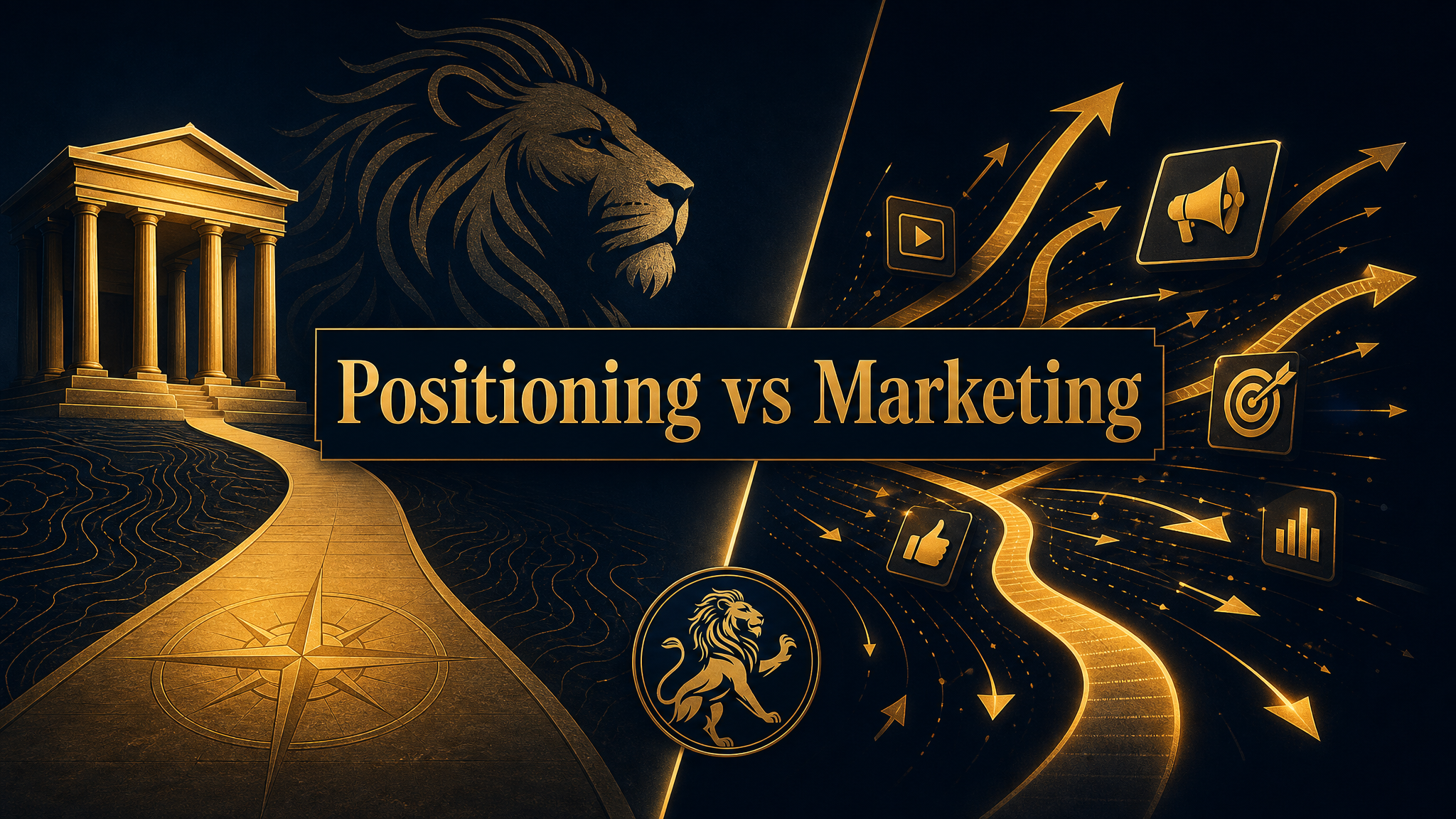
Positioning vs marketing comes down to meaning versus motion. Positioning defines the place a business owns in the buyer's mind, while marketing carries that meaning into channels, campaigns, content, and sales conversations.
Al Ries and Jack Trout made the core point in Positioning: The Battle for Your Mind: positioning is about the mind of the prospect, not just the product itself. The American Marketing Association defines marketing as the activity and institutions used to create, communicate, deliver, and exchange offerings that have value.
That distinction matters for professional service firms.
I've seen smart attorneys, advisors, and consultants treat a visibility problem as a marketing problem when the deeper issue was market meaning. They bought ads, posted content, rewrote web pages, and still sounded like every other firm in their category.
That's expensive noise.
Get an Authority Lion Snapshot if your firm needs to know whether the market can already understand why you're the clear choice.
How Do Positioning vs Marketing Compare Side by Side?
| Feature | Positioning | Marketing |
|---|---|---|
| Core job | Define market meaning | Carry that meaning into the market |
| Main question | "What should we be known for?" | "How do we reach the right people?" |
| Level | Business strategy | Channel execution |
| Time horizon | Long-term | Ongoing |
| Main output | A clear place in the buyer's mind | Demand, awareness, and buyer action |
| Risk when weak | The firm sounds interchangeable | The firm stays unseen or unheard |
Positioning sets the room before the conversation starts. Marketing walks into that room and speaks.
One comes before the other.
What Is Positioning?
Positioning is the strategic choice of what a business should mean to a specific buyer. It answers who the firm serves, what problem it is trusted to solve, why that work matters, and what makes the firm different from close alternatives.
Think of positioning like the name card on a reserved chair.
If the chair is clearly marked, the buyer knows where you belong. If the chair is blank, marketing has to keep introducing you from scratch.
For Authority Lion, positioning matters because expert-led firms do not win by sounding louder. They win when the market can repeat why they matter.
Strong positioning answers 4 questions:
- Who is the exact buyer?
- What problem has that buyer failed to solve?
- What proof makes the firm credible?
- What category should the firm own in the buyer's mind?
Without those answers, marketing becomes motion without memory.
What Is Marketing?
Marketing is the set of activities used to communicate, deliver, and support a business's value in the market. The AMA definition includes creating, communicating, delivering, and exchanging offerings that have value.
Marketing includes content, advertising, email, search, social media, events, sales support, and referral support.
Marketing is not the enemy.
Bad marketing is usually a symptom. The deeper problem is that the message has no sharp position behind it.
HubSpot's 2026 marketing statistics show how much channel activity now competes for buyer attention: 69.6% of marketers use Facebook, 70% use Instagram, and 43% rank Facebook among the highest ROI social platforms. Those channels can create reach, but reach does not fix unclear meaning.
That's the split.
Positioning decides what should be remembered. Marketing decides where and how that memory gets repeated.
How Do Positioning vs Marketing Work Together?
Positioning gives marketing a spine.
Marketing gives positioning public proof.
The sequence should look like this:
- Define the firm's position.
- Translate that position into messaging.
- Build content and campaigns around that message.
- Support sales conversations with the same proof.
- Measure what buyers remember, not just what they click.
This is where many firms lose money. They ask a campaign to fix a positioning gap. It cannot.
A campaign can spread a message. It cannot make a weak message strong.
Authority Lion's services are built around this distinction because professional expertise needs more than promotion. It needs a clear public identity that buyers, referral partners, search engines, and AI answer engines can understand.
What Happens When Positioning vs Marketing Get Confused?
When positioning and marketing get confused, firms start measuring activity instead of meaning.
They ask:
- Did the post publish?
- Did the ad run?
- Did the email send?
- Did the traffic rise?
Those are marketing questions.
The positioning questions cut deeper:
- Can a buyer explain why this firm is different?
- Does the firm own a clear issue, category, or point of view?
- Would a referral partner know exactly when to introduce the firm?
- Do AI answer engines have enough clear proof to describe the firm correctly?
Edelman's 2024 Trust Barometer reported business at a trust score of 63, ahead of NGOs at 59, government at 51, and media at 50. Trust is still available, but vague firms do not receive it automatically.
The 2024 Edelman-LinkedIn B2B Thought Leadership Impact Report surveyed management-level professionals across 7 countries. That report exists because buyers use ideas, proof, and expertise signals to decide who deserves attention before a sales call starts.
Marketing gets the idea into circulation. Positioning makes the idea worth circulating.
Get an Authority Lion Snapshot before you spend more money pushing a message the market may not remember.
When Should You Fix Positioning Before Marketing?
Fix positioning before marketing when the business has an identity problem.
Choose positioning first if:
- Buyers compare you mainly on price.
- Your website could belong to 12 other firms.
- Referral partners struggle to explain what you do.
- Your content sounds competent but forgettable.
- Competitors with less expertise appear more visible.
- Your sales calls require too much explanation.
Fix marketing first only when the position is already clear.
Choose marketing first if:
- Buyers understand your difference.
- Your offer has a clear audience.
- Your proof is specific.
- Your message is consistent.
- The firm needs more reach, not more clarity.
This works best when leaders are honest about the real failure.
A firm with clear positioning and weak marketing has a distribution problem. A firm with weak positioning and active marketing has a meaning problem.
Those are different problems.
Which Positioning vs Marketing Mistake Costs the Most?
The most expensive mistake is funding marketing before the firm has earned a clear position.
That creates polished confusion.
The campaign may look professional. The copy may sound clean. The traffic may rise for a while. But the buyer still cannot say why this firm, why now, and why not the other firm down the street.
For expert-led businesses, that is the gap that matters.
Authority work begins before promotion. The firm needs a point of view, proof, category clarity, and language a serious buyer would repeat without feeling sold to.
That is why how Authority Lion works starts with clarity before visibility.
Which Should Come First: Positioning or Marketing?
Positioning should come first because it gives marketing something worth repeating.
Marketing matters. It creates reach, frequency, and demand. But marketing without positioning is like sending invitations to an event with no name on the door. People may arrive, but they will not know why they came.
In my work with professional service firms, the pattern is plain: the firms that win are not always the loudest. They are the easiest to understand, the easiest to trust, and the easiest to recommend.
Fix that first.
Then market it.
For more context on the firm behind this approach, visit About Authority Lion or review the Authority Lion FAQ.
Get an Authority Lion Snapshot if your firm needs to find out whether its market position is clear enough to support real growth.